
How it all started
This project began as an ordinary build of a catalog website for cars from Asia, but it quickly became far more interesting. I had to gather information literally bit by bit from Telegram, come up with the design of the cards, extend the standard Tilda blocks with code and gradually automate the filling of the catalog.
The clients who came to me supply cars from China, Japan, South Korea and Thailand to Russia.
At that time they were actively growing a Telegram channel. It regularly featured photos of cars, short reviews, videos from shipments, technical specifications and delivery information.
Telegram is great for publishing news and talking to an audience. But once there are many offers, it gets harder to find your way around.
A potential buyer has to scroll through the message history, look for the right model and match photos with specifications.
So the clients decided to build their own website with a full car catalog.
A visitor was meant to be able to choose a brand, browse the offers, look at the specifications and send a request. Later the site was planned to be used for contextual advertising and search promotion.
Tilda was chosen for the build. It allowed the project to launch fairly quickly without big costs and kept the option of managing the content independently.
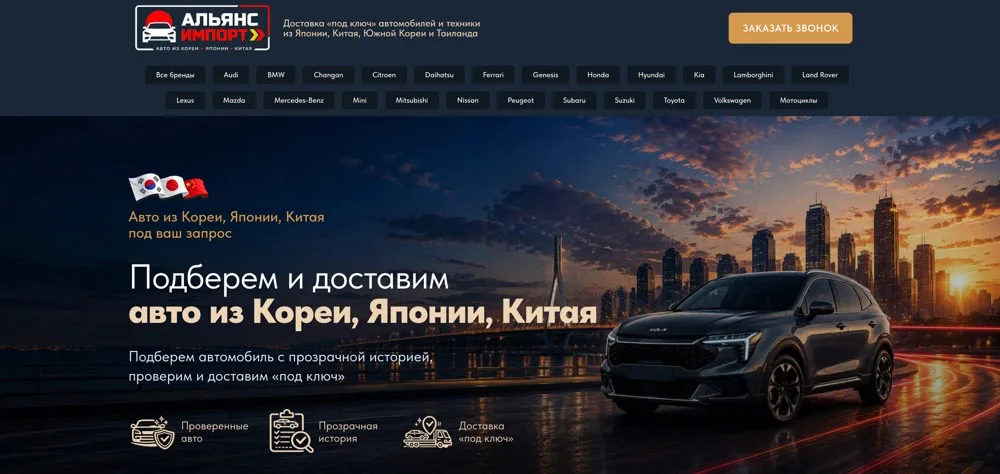
I took the structure from earlier car projects
Before this I had already built a network of websites selling heavy trucks. While working on them, a successful catalog structure took shape that could be used for other car markets too.
I decided to take it as the base.
The result was a multi-page architecture with a home page, catalog sections, brand filtering and full internal car pages.
I like it when a site’s structure is designed with further growth in mind.
Today the catalog has one number of offers, tomorrow another. New brands, models and supply routes appear. With a sound architecture, all of this can be added step by step without rebuilding the site each time.
In addition, separate car pages make it possible to build search promotion by brand and model and to use them in ad campaigns.
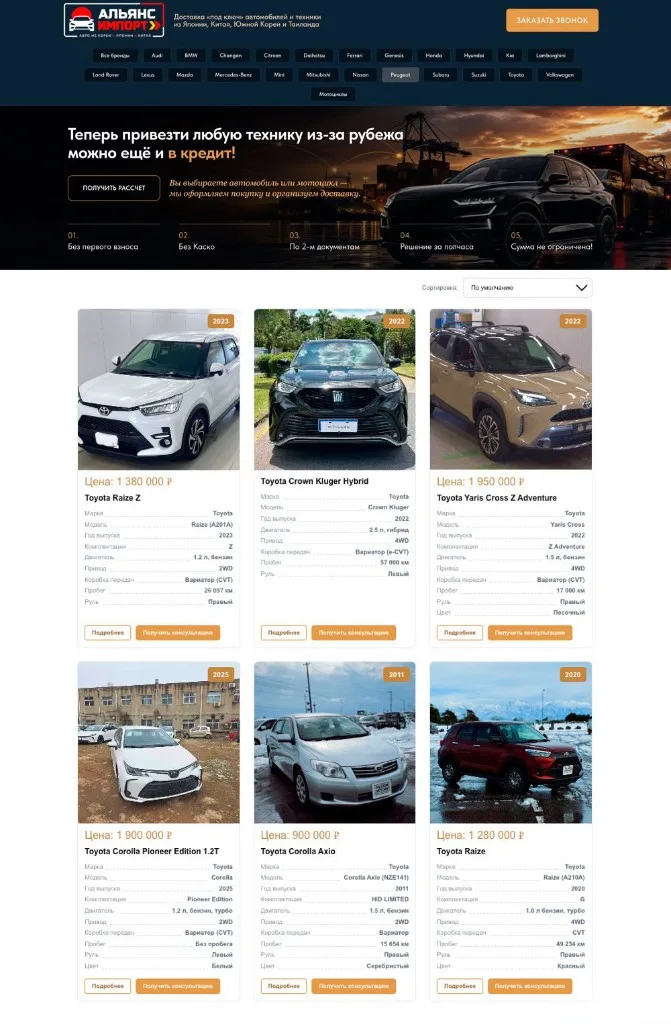
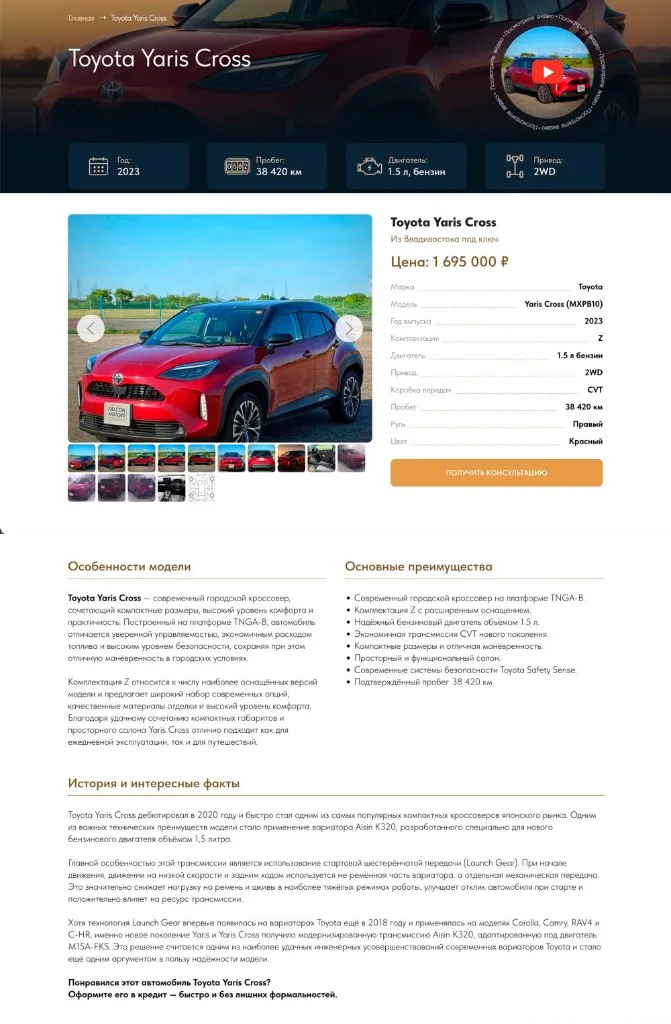
Telegram turned out to be an adventure of its own
When it came to filling the catalog, it turned out that the source materials looked nothing like the usual table of products with names, specifications and photos.
Everything lived in Telegram.
Moreover, the information about a single car could be scattered across several messages published days or even weeks apart.
For example, first came a short post with the car’s specifications. A few days later, photos. Then a video. And some time after that, pictures of the car at the shipping site.
Between these posts there could be dozens of messages about other cars.
As a result, I had to carefully go through the channel history, look for related messages, match photos and videos and work out which materials belonged to a particular car.
Sometimes preparing a single card meant going through posts from several weeks.
It turned out to be one of the most labor-intensive parts of the project.
Why I had to work on the content as well
Most Telegram posts had one more feature: very brief content.
A few specifications, a couple of sentences and photos.
That is perfectly fine for Telegram. But on the site I wanted to give visitors more information.
So I decided to expand the cards myself.
I prepared more detailed car descriptions, added technical details, wrote about the features of the models and included interesting facts and a bit of history.
That way, instead of short posts, full pages appeared where you can get to know a car in more detail.
This matters to me: even the most beautiful catalog loses its point if a visitor can learn almost nothing about the product.
First everything by hand, then automation
At the first stage, filling the catalog went roughly like this: save the materials from Telegram, work out which car they belong to, choose the photos, prepare the description, place everything on the site and check the result.
Then repeat the whole process for the next car.
It quickly became clear that part of this work could be automated.
Gradually I started introducing solutions for exporting materials from Telegram and then moving them to the site.
Over time, automation covered more and more operations.
But I did not give up manual work completely.
First, the source materials are not always structured well enough. Second, even after automatic processing, the content often needs clarifications and corrections.
And there is one more thing: I am quite demanding about the quality of finished pages.
If an image looks unsuccessful, a description needs work or some interface element does not satisfy me, I prefer to fix it by hand.
So in this project automation helps me get rid of repetitive operations, while the final check and bringing the result to the right level remain mine.
My favorite part of the project: the design of the cars
The site needed quite a lot of graphics.
I created images for the first screen of the home page, banners and internal sections.
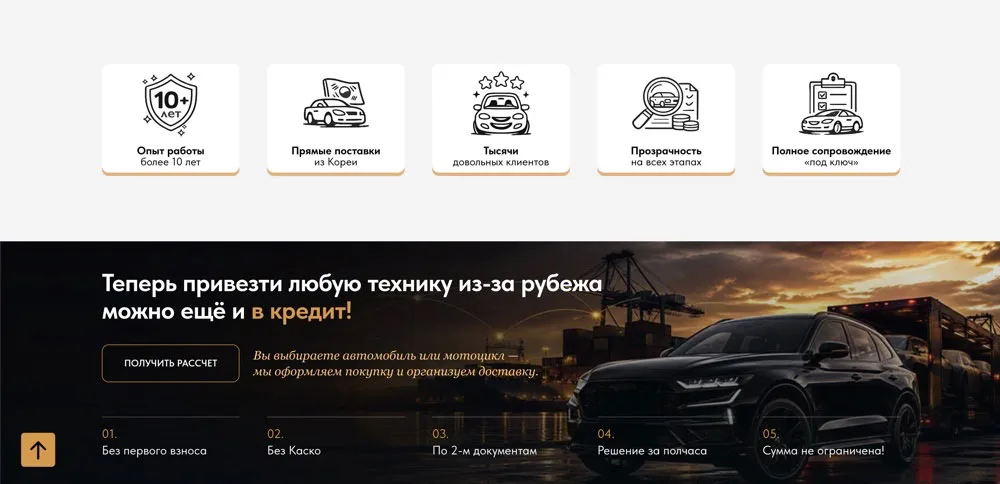
But I especially liked the idea I implemented on the individual car pages.
Usually the first screen of a car page looks fairly standard: the model name, photos, specifications and a request button.
I wanted to make it more expressive.
That is how the idea came up to use a large image of the car in evening light as the background.
I generated such a picture separately for each model.
Evening light beautifully emphasizes the car’s silhouette, the lines of the body, the headlights and other details. And a large heading with the model name looks good on top of the picture.
As a result, every page got its own atmosphere.
At the same time, all the cards follow one principle: the same composition of the first screen, the same placement of headings and a common style of images.
I like that this approach makes even a big catalog visually interesting while keeping the design consistent.
How I extended the standard Tilda blocks
Building the site was not limited to configuring standard blocks.
From the very beginning I actively used CSS and JavaScript to change the look and behavior of the catalog elements.
I refined the product cards, the design of the car previews, the brand filtering and individual interface elements.
It was important to get exactly the look I had in mind while keeping the site easy to manage.
This is one of the reasons I enjoy working with Tilda.
Ready-made blocks let you assemble the base of a project quickly. And your own styles and scripts let you change the interface, extend the standard functionality and create custom solutions.
As a result you can build a fairly complex site without giving up the advantages of a builder.
In the “Iz Korei” project, the combination of Tilda’s standard features, custom code and automation achieved exactly that.
Requests must reach the clients quickly and reliably
Another part of the build is how requests are received.
I provided several entry points: forms are placed on the home page, in the car previews and directly in the cards.
A visitor can send a request right after becoming interested in a particular car.
To deliver requests, I use a proven scheme with four channels.
Requests are saved in Tilda’s built-in CRM and also arrive in Google Sheets.
Notifications come by email and through a Telegram bot.
I like this scheme for its practicality.
Clients can quickly learn about a new request in their usual messenger, and if they need to find an old request, they can open the CRM or the spreadsheet.
At the same time, the information is stored in two independent systems, which gives extra safety for the request history.
The result
The result is a multi-page “Iz Korei” website with a catalog of cars from Asia, brand filtering, full model cards and a system for receiving requests.
But personally, I find this project interesting also because of how it developed.
First came a proven catalog structure. Then painstaking work with Telegram posts. Then individual images, modifications of standard blocks and, gradually, automation of content filling.
Each new stage added functionality to the site and made working with it easier.
In this project I managed to combine several areas that are especially interesting in development: the architecture of a multi-page site, programming, design, content creation and automation.
These are the possibilities I love Tilda for. When you know the platform well and can work with your own code, you can build complex projects with a custom interface and a well-thought-out structure.
And I also like it when development does not end with the site’s publication. The project leaves room for improvements, new features and further growth.
View the “Iz Korei” website: izkorei.alliance-car.ru.
A catalog on Tilda for your project’s goals
If you need a catalog website with its own structure, extended blocks and automated content filling, I can build it on Tilda and support it as the project develops.