
Telegram Mini Apps make it possible to build full interactive services inside the messenger: catalogs, learning apps, consultation booking, ordering and client management. For the “Taro i Teni” project I built exactly this kind of app, combining a free Tarot card reference with a service for personal video readings. Here is how the project works, which decisions I made and which technical problems I ran into.
The “Taro i Teni” project: how it all began
“Taro i Teni” is an author’s project by Karina Ter-Grigoreva, devoted to Tarot and personal video readings.
First I built the Tilda landing — the site taroiteni.ru. I created a visual style, the information sections and the descriptions of services and rates. More about the website is in a separate case study. The author also runs a Telegram channel where she talks to her audience.
Over time the idea appeared to expand the project and build an interactive service that visitors could use right inside Telegram.
I was interested in building an app where free features are combined with commercial services. I also wanted to keep a visual link with the website and leave room for further growth.
Why the Telegram Mini App format fit this project
The project already had an audience in Telegram, so building an app inside the messenger looked like a logical step.
The main advantage of Telegram Mini Apps for the user is that nothing has to be installed. The app opens from a link or through a Telegram bot. At the same time the user gets a familiar mobile interface with screens, buttons, catalogs and interactive elements.
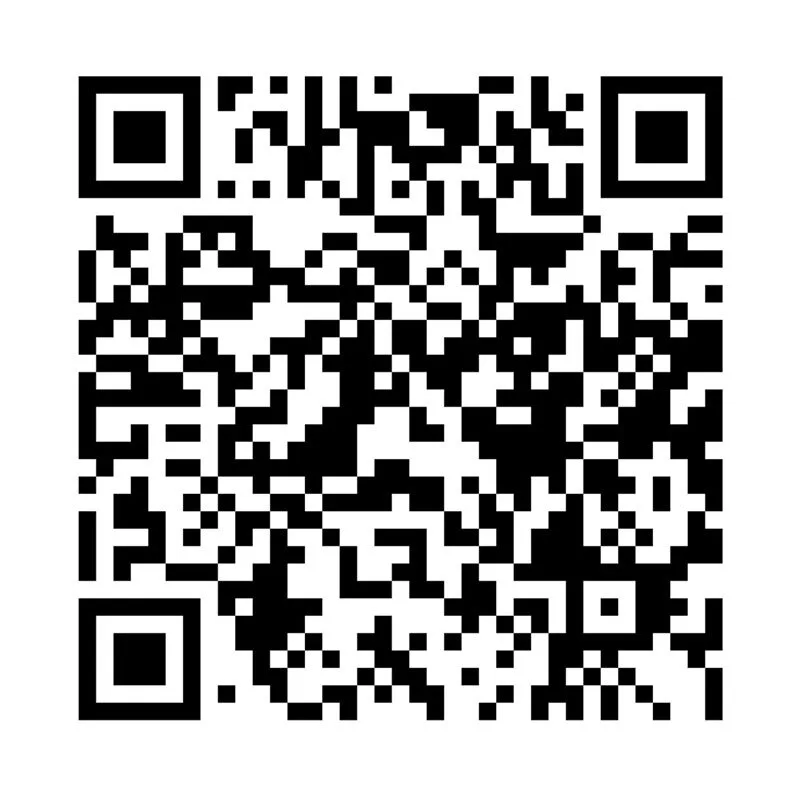
I provided several ways to get into the app. One of them is a QR code placed on the main “Taro i Teni” website.
A visitor can scan the code with a smartphone and open the app right in Telegram.
The result is a connected structure of three platforms:
Website
An introduction to the project, the author and the services.
Telegram channel
Posts and conversation with the audience.
Telegram Mini App
An interactive reference and an additional way to interact with the project.
The same approach works in other niches. For example, an online store can get a mobile catalog inside Telegram, an educational project an interactive library of materials, and a consultant a booking and request management service.
How I defined the features of the first version
One of the key tasks in development is deciding which features are really needed at launch.
From the start it was possible to plan personal accounts, order history, built-in payment, an internal chat and other features. But every extra decision increases the scope of development and makes the app harder to maintain.
That is why I chose a step-by-step approach.
In the first version I focused on two user scenarios:
- A visitor opens the app, explores the Tarot cards, uses search and saves the materials they like.
- A visitor learns about the topics of personal video readings, looks at the rates and goes to the request form.
Using the reference does not require a separate registration. Favorite cards are saved on the user’s device.
I decided to leave built-in payment, order history and a full personal account for later stages.
This let me concentrate on the interface, the content of the catalog and the quality of the core features.
The result: an interactive catalog of 78 Tarot cards
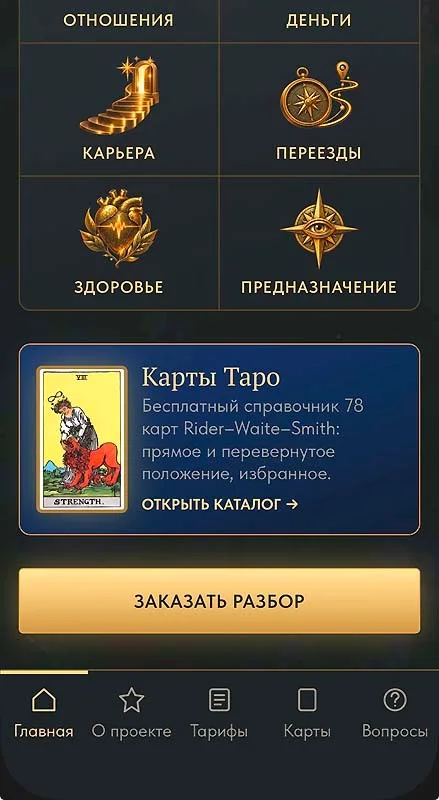
The core of the app is a digital reference of the classic Rider-Waite-Smith deck.
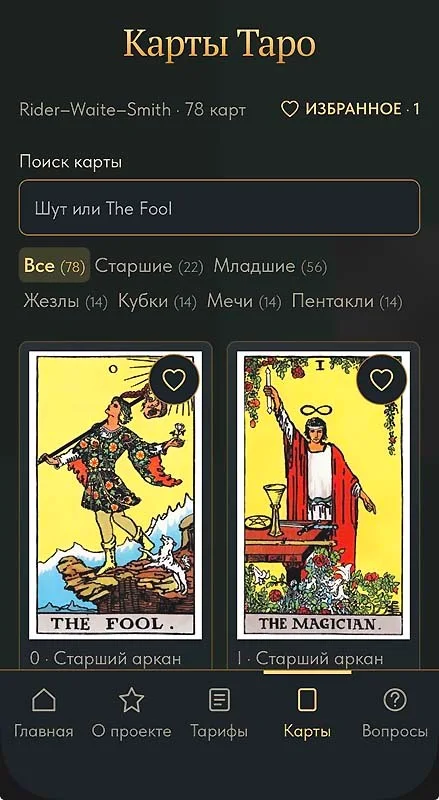
It contains 78 cards: 22 Major Arcana and 56 Minor Arcana.
I designed an interface where you can browse the full catalog, find cards by name and open separate pages with detailed interpretations.
Search and filters
The catalog has search by Russian and English names and filters by card category.
The user can quickly get to the right arcanum without scrolling through the whole deck.
During development I paid attention to checking the data: the completeness of the deck, card names, images and the content of the text sections.
Cards with interpretations
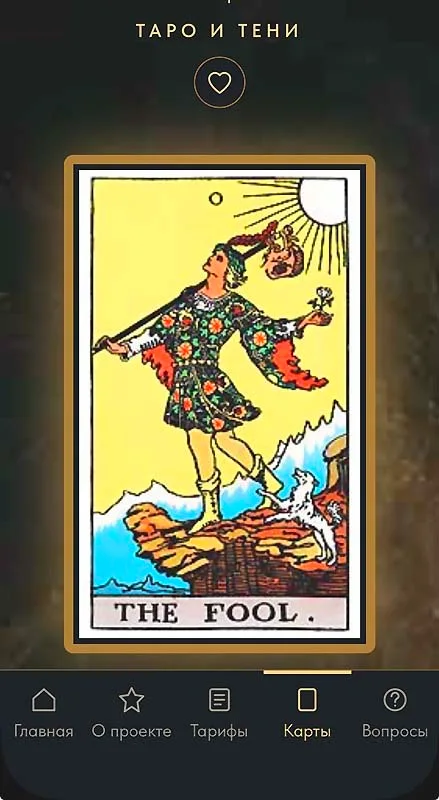
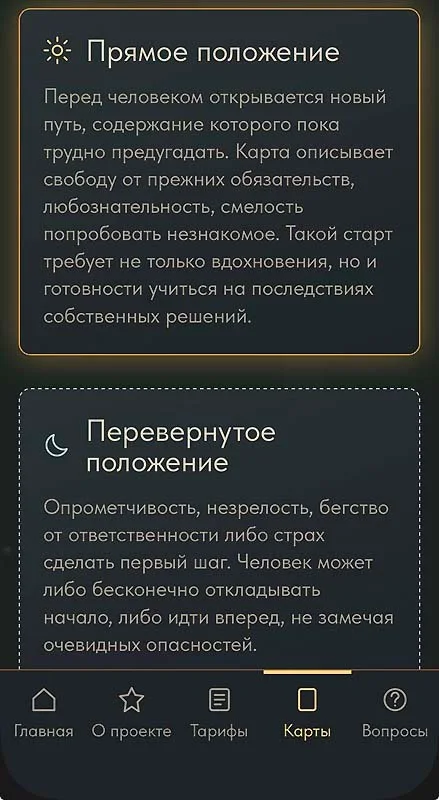
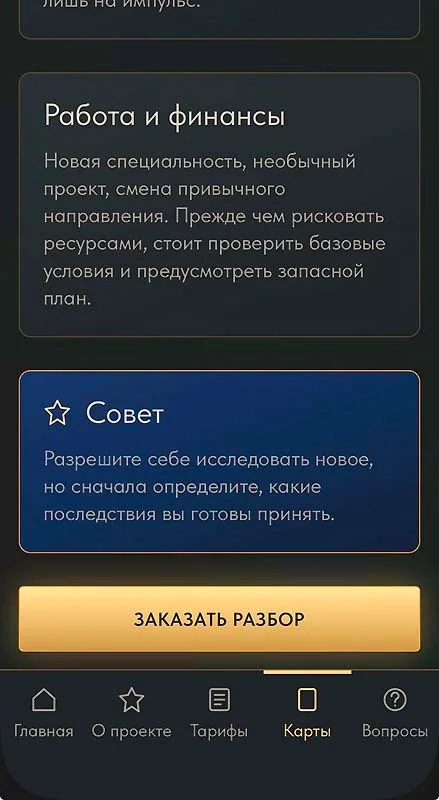
Every card has its own page with an image and a description.
This format is convenient for studying the deck step by step. The user can open a card and read the material right inside the app.
Favorite cards
I added the ability to save cards to favorites.
The selection stays available when the app is reopened on the same device, as long as its local data is kept.
For a small reference this is a practical solution: the user gets a useful feature without registering or creating a separate account.
Later, if needed, favorites can be linked to a personal account and synchronized between devices.
How the personal video readings section works
Besides the free catalog, the app has sections about the commercial services of the project’s author.
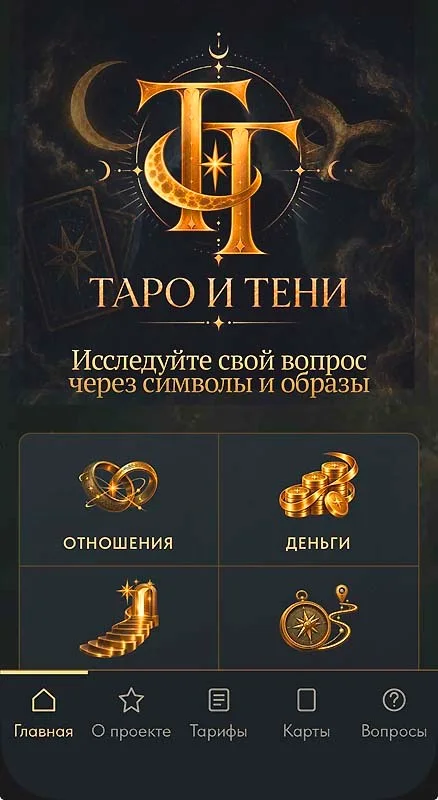
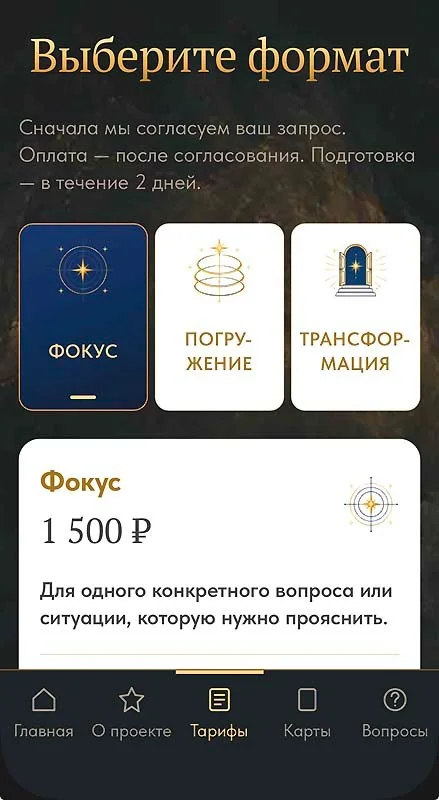
The main screen shows six themes of personal video readings.
A visitor can pick a theme, read the terms and look at the rates.
For placing a request I built a form with three main fields:
- Name — a pseudonym can be used.
- Topic of the request.
- The question for a personal reading.
The form interface is ready for connecting automatic delivery of requests through a Telegram bot.
Once this integration is built, the author will receive requests directly in Telegram. Later the system can be extended with notifications, order history and an admin interface.
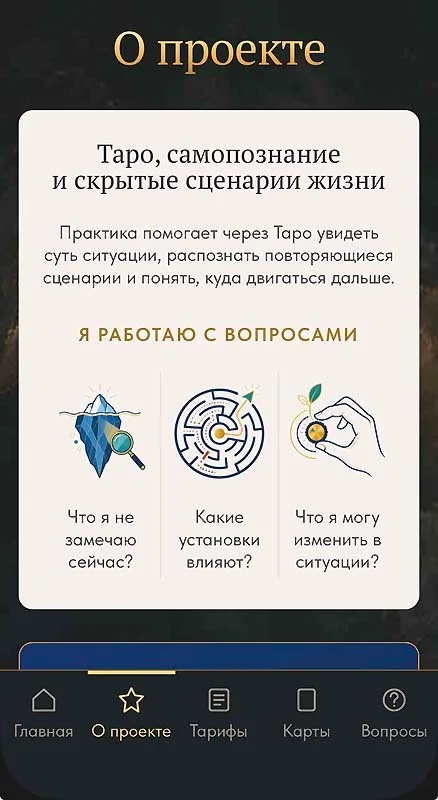
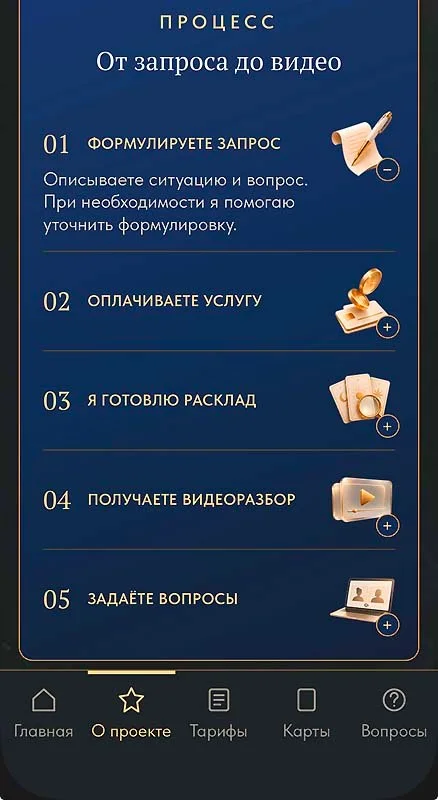
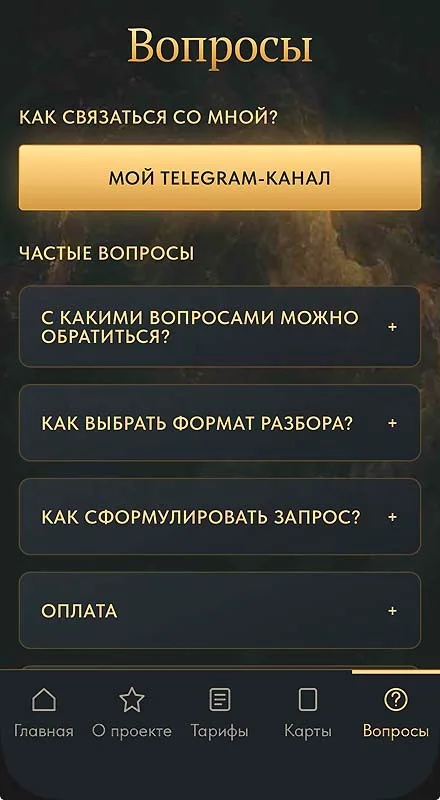
Separately, I added information sections: about the project, a description of how to get the service in five steps, rates and answers to questions.
This lets a visitor find all the necessary information on their own before getting in touch.
Design: keeping the website style in a mobile app
Since “Taro i Teni” already had a website, I decided to keep its visual style in the Telegram Mini App.
At the same time the app interface needed separate design work. On a small screen you have to think about the position of buttons, image sizes, navigation access and the behavior of interactive elements.
I paid special attention to the card catalog. The images had to stay large enough to be seen well, but not overload the screen.
I prepared the first layouts in Claude Design and then moved on to building the interface.
During development I repeatedly checked the app directly in Telegram on a smartphone.
In total there were more than 20 interface adjustments. I refined element sizes, button positions, the look of individual screens and the behavior of components.
I also checked responsiveness at widths from 320 to 430 pixels.
For me it is essential to evaluate the finished interface on a real device. Even a carefully prepared layout can need serious rework after testing in a mobile environment.
Graphics optimization: reducing the weight of the app
Images for a mobile app should be prepared in an optimized form in advance: their weight determines how fast the app loads.
The app uses 78 Tarot cards, decorative elements and icons. The original graphics turned out to be rather heavy for a mobile interface.
Because of the large number of files, images took longer to load than I wanted.
I reviewed the sizes of the graphic resources and prepared lighter versions of the files.
As a result I got the following figures:
- The weight of the first screen dropped from 2.4 to approximately 0.9 MB.
- The amount of loaded data was reduced by about 62.5%.
- The size of individual icons dropped from 227-380 KB to 13-17 KB.
- Catalog images began to load faster.
The cards were also prepared at a more compact resolution that matches the needs of a mobile interface.
This stage once again confirmed how important graphics optimization is for apps with many images.
When designing such services, I now take the weight of graphic resources into account already when preparing the design.
Specifics of developing inside Telegram
Telegram Mini Apps have technical specifics that must be taken into account in development and testing.
I ran into one of them while testing the app.
In a regular browser everything opened correctly. But when launched inside Telegram, a “Page not found” error sometimes appeared.
The cause turned out to be related to how addresses are handled. Telegram added service data to the URL, and the app’s navigation mechanism processed it incorrectly.
After analyzing the problem I changed the way routes are handled and fixed the error.
This case showed how important it is to test the app directly inside Telegram.
I paid separate attention to checking the catalog, search, favorites and image loading. Automated checks were prepared for the project’s data and for some of the app’s mechanisms.
Result: the first version of the Telegram Mini App is published
The development resulted in a working app that complements the “Taro i Teni” landing and the site taroiteni.ru.
The first version includes:
- A main page with six themes of video readings.
- An interactive reference of 78 Tarot cards.
- Catalog search and filtering.
- Cards with images and interpretations.
- Saving favorite cards.
- Sections about the author and how to get the services.
- Rates and answers to questions.
- A request form interface.
- Entry from the main website via a QR code.
The app is adapted for mobile devices, the graphics are optimized and the core features have been tested.
For the project this is an additional digital platform that gives the audience a free interactive service and introduces the author’s personal services.
The first version has also become a basis for further expansion of the features.
How the app can grow further
At the stage of the first development I deliberately limited the set of features, but I kept the possibility of further growth in mind when designing.
A Telegram Mini App has wide potential: as the project grows, new modules and integrations can be added to the original interface.
Several directions are being considered for “Taro i Teni”.
Interactive spreads with artificial intelligence
The app can get a feature for self-service spreads.
The user chooses cards and then receives an automated interpretation made with the help of artificial intelligence.
Later it is possible to add different types of spreads and paid features of the service.
Automating request intake
The next step is connecting the request form to a Telegram bot.
This will let the author receive messages about new requests directly in the messenger.
In addition, you can build automatic notifications, order status changes and other tools for working with requests.
A personal account for the project’s author
For Karina a separate admin interface can be developed, with information about how the service is doing.
Such an account can include viewing requests, order history, client cards, status changes and search through requests.
As the project grows, the features can be extended with rate management, financial indicators and other tools.
Statistics and analytics
Another promising direction is connecting analytics.
For example, you can track the number of visitors, the popularity of sections, the demand for video reading themes, the dynamics of requests and the number of completed orders.
This data will help the author understand the audience’s interests and make decisions about the project’s development.
Integrations with external services
If necessary, the app can be extended with online payment, a CRM, a notification system and other integrations.
This way the original reference can gradually turn into a more functional service for working with clients and managing orders.
What this project gave me as a developer
Working on “Taro i Teni” let me combine several areas I work in: interface design, development of digital products, content creation and integrating a website with additional services.
Preparing lightweight graphics, adapting the interface to Telegram and defining the features of the first version turned out to be especially important.
This app shows well how a small author’s project can be developed step by step: first create a website, then add a Telegram Mini App, and later connect automation, analytics and new user features.
This approach works for different kinds of business. For one project it can be an interactive reference, for another a product catalog, an educational service or a client booking system.
In every case I start by studying the task and designing user scenarios, to decide on a suitable set of features and the options for further growth.
Telegram Mini Apps for the needs of your project
I develop websites and digital services, including Telegram Mini Apps for businesses, experts and author projects.
Depending on the task, it can be a compact app with a few screens or a more complex service with personal accounts, payment, analytics and integrations.
In development I pay attention to structure, ease of use, technical quality and the possibility of expanding the features later.
If you are planning your own app inside Telegram, tell me about your idea.
I will help you decide which features are needed at the first stage, how to organize user scenarios and how the app can grow together with your project.